“Wouldn’t the world be better if more people didn’t have kids?” asks Nikhil Kamat in his conversation with Ajay Banga, President of the World Bank, in the interview for his People by WTF series. (Youtube).
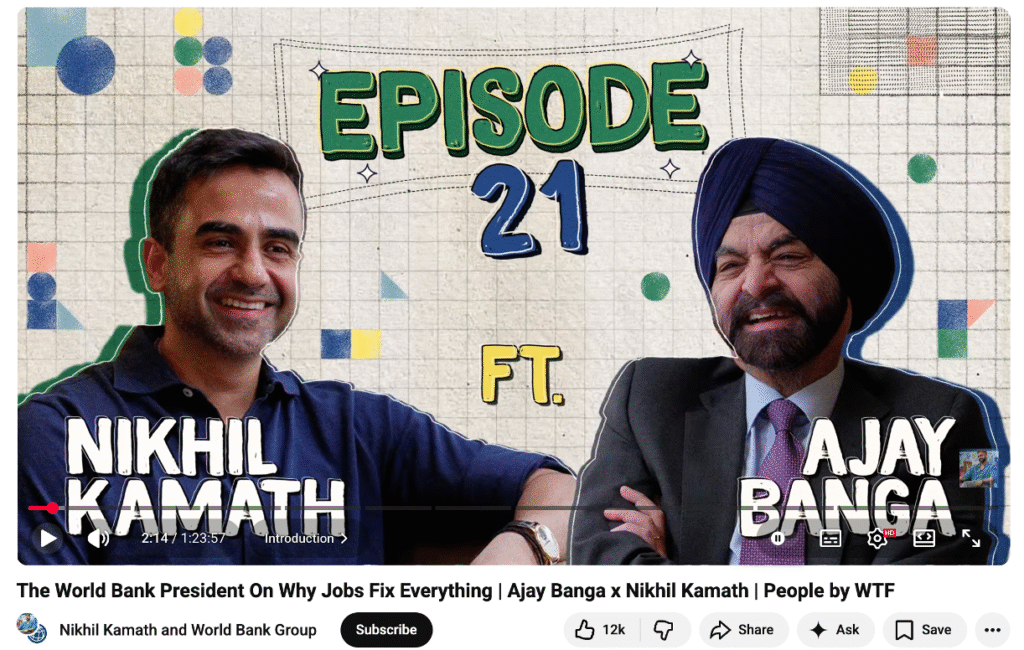
In the engaging conversation (as always) marked by meaningful pauses, optimistic vibes, curiosity of questions, clarity of answers, and the humility of ‘don’t-knows,’ the answer for this question was of course predictable. The human race needs to last.
And I remembered some news from the year 2019. Then, a young man by name Raphael Samuel from Mumbai became a viral sensation, with global media coverage when he announced his intention to sue his parents. Reason? For bringing him to this world without his consent, where he must put up with lifelong suffering.
To be sure, this is not the first time the question of population has come up. It was in 1798, Thomas Malthus wrote An Essay on the Principle of Population that warned of the perils of population growth. That population growth will be exponential, while food production will be linear. A couple of hundred years and many technological advances later, the Malthusian hypothesis in a way stands discredited. The population grew. Food production caught up. At what cost depends on whom you ask.
The debate between a Malthusian apocalypse and the optimism of human ingenuity never died. In the mid-20th century, two scientists with diametrically opposing views perhaps provided the intellectual framework for the battle to continue. As populations and consumption grow, will the planet be enough to meet our demands versus science and technology will see us through.
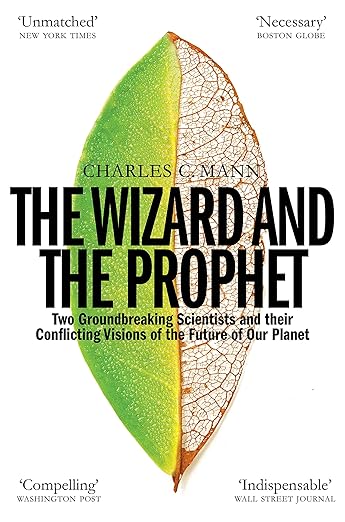
William Vogt, born in 1902, belonged to the first school. He believed the planet cannot sustain our consumption pattern. In 1948, he published the hugely popular The Road to Survival which by all records set the foundations for modern environmentalism. The key tenet was—reduce consumption, if not we all are going to hell. (The Road to Survival also incidentally inspired Rachel Carson’s Silent Spring, a landmark book on environmentalism.)
Norman Borlaug, born in 1914, who can be considered the techno-optimist, was in fact the key figure in the research that led to the Green Revolution of the 1960s. Borlaug believed affluence is not the problem, but a solution. By getting richer and smarter, we can create the science to resolve our environmental dilemmas. (Read the fascinating story of these two journeys in The Wizard and the Prophet: Two Groundbreaking Scientists and Their Conflicting Visions of the Future of Our Planet.)
In 1968 Paul Ehrlich, a German biologist published The Population Bomb, bringing the Malthusian prophecy back to public discourse. In 1966, the population of the world increased by 70 million, without adequate increase in food production and resultant calamities. In the subsequent decades, with the advances of technology and a decline in global fertility rate (from 5 in 1960 to 2.7 in 2000), Ehrlich fears were unfounded. Especially in food production (and not in environmental degradation). On conservation, he then said “In spite of all the efforts, all the propaganda, all the eloquent writing, all the beautiful pictures, the conservation battle is presently being lost.” (Incidentally, Earth Day started in 1970 in the United States, and since 1990, it has become a global event. And we know where the graph has moved.)
The population continues to grow and is expected to stabilize by around 2080 at about 10.5 billion and start declining towards 2100. That’s another 2 billion more from current numbers.
Yet, declining population is a major concern cited by economists for the progress of humankind. Some parts of the world, especially developed countries are experiencing population decline, with fertility rate far below replacement levels. And these countries are indeed worried. South Korea, Japan, China, the United States, some European countries, and even some parts of India. In fact, the population projection for China in 2100 is similar to that of the 1950s. In a recent interview, the MD of Morgan Stanley mentioned that India’s biggest challenge in the future is going to be a declining population.
When the average lifespan increases and fertility rate decreases, eventually there will not be a young population for productive work and everyone suffers. The beginning of slow death. Yes, it is a grave concern.
So, the world needs more children.
But …
Why do the South Koreans not want more children? The reasons stated are high cost of living, intense work culture, extreme academic pressure, and career damage because of gender inequality.
Why are Chinese marriages plummeting? Economic hardship, very high housing prices, the cost of raising children, and youth unemployment. (There is also an argument that the one-child policy, though discarded now, has had an impact on the attitude towards marriage. But the economic hardship is a reality).
Why are Japanese not marrying and having kids? Wage stagnation, rising costs, housing prices, intense work culture, and career opportunities.
In the United States, the millennials are said to be the first generation of Americans ever who will be worse off than their parents’ generation. Reasons stated are wage stagnation (while productivity and corporate profits have gone up since 1970, inflation adjusted wages have stagnated), rising housing costs, high student debts, and more gig work than regular work.
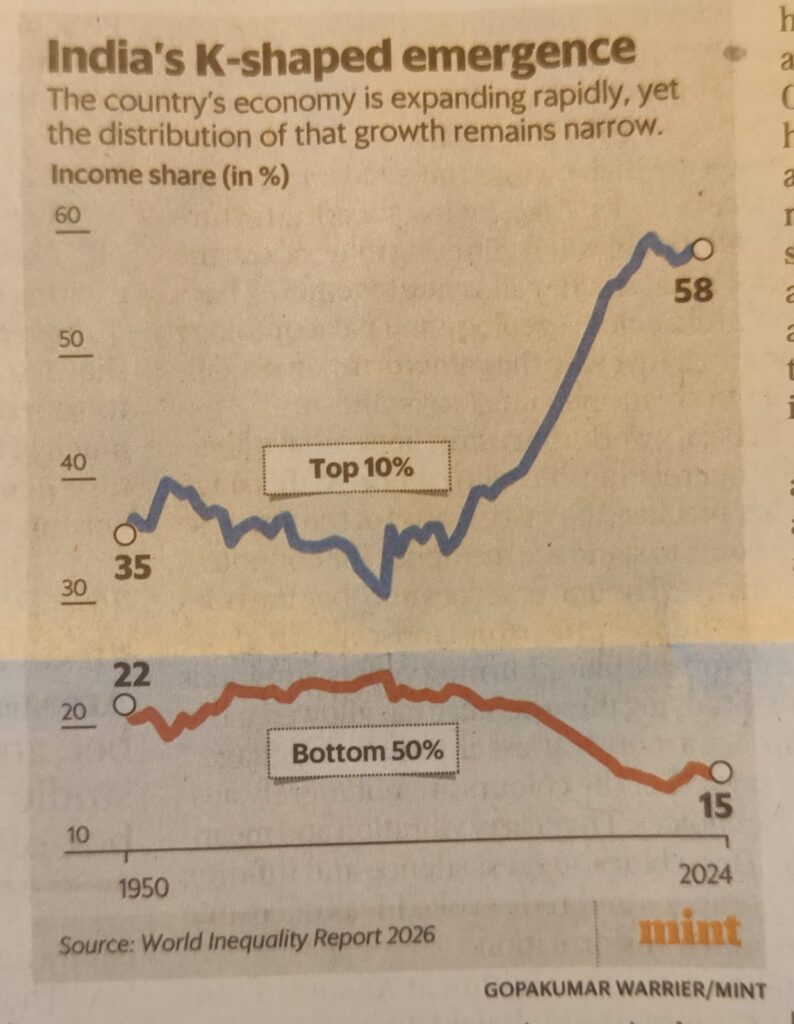
Even in India, with the infamous K-shaped recovery, the incomes of the top 10% have risen sharply, while the bottom 50% have seen their incomes going down. Rising corporate profits and stagnant real wages prompted the Chief Economic Adviser to the Govt of India to call upon the corporates to increase wages for what he rightly called the ‘Enlightened Self-Interest.’ If there is no sufficient income for a large share of the population, consumption is going to fall, affecting the very same corporates.
Common thread across the countries—rising cost of living.
If economies are growing, wealth is getting created, innovation is happening, why is it that large sections of populations are finding it difficult to live? We don’t even know the impact of AI.
So, why do we need more people, if not for the suffering? For the economic charts to look good. For the GDP numbers to look good. The average per capita income also might look good. But don’t trust the average. As the joke goes—Bill Gates walks into a bar, and the average per capita income of all the people in the bar went up significantly. You get the gist.
Should we solve inequality or poverty first is another larger debate that economists and intellectuals engage with. That’s beyond the scope of my current stage of brain growth. But this is not about capitalism versus socialism versus some other ism. Wealth concentration is real. Consequences are also real. (We will not wade into ecological impact, but the economists say they are just ‘externalities’).
If not any isms, at least ‘Enlightened Self-Interest’ should prevail?
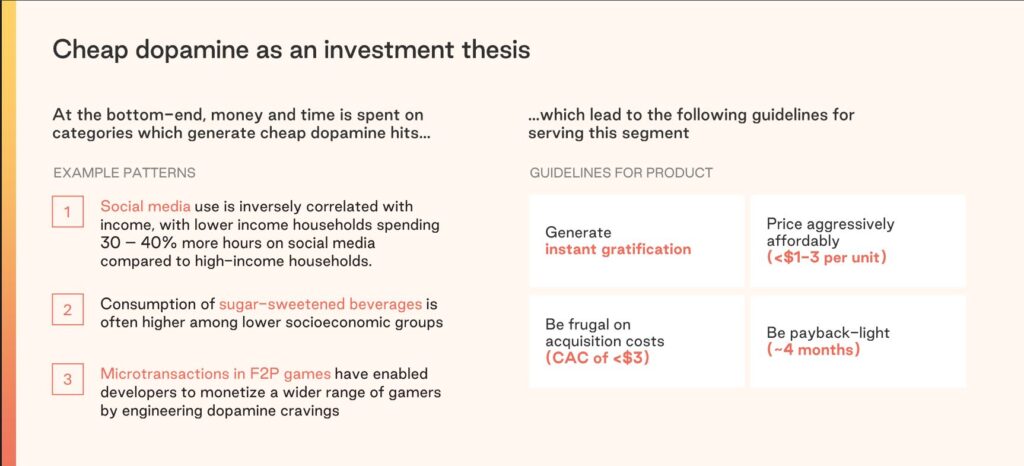
Sometime last year, one slide from VC firm Lightspeed SE Asia was widely circulated and criticized. Because the investment thesis was that among low-income people, money spent is on cheap dopamine cravings and those are the businesses (social media, free-to-play games with micro transactions, and sugar-sweetened beverages) that they will invest in. Systematic wealth transfer upwards in the most legally legitimate way. Trickle-down theory was the promise of economic growth. But instead, what we see is a spiral-up.
So, as the ways of working of this world stand today, what’s the point in having more children?
In other words, in whose dashboard, what metric are you?
P.S: There will be many counter views to this—on economic models, the moral imperative of economic growth, on the primacy of human ingenuity, on entrepreneurship, on trade, and more. And maybe interesting solutions. I am only happy to hear everything. What if everything I said is based on some flawed logic? I am happy to stand corrected.
Sources / References:
- Nikhil Kamat x Ajay Banga Conversation
- Book: The The Wizard and thMillee Prophet: Two Remarkable Scientists and Their Dueling Visions to Shape Tomorrow’s World
- BBC: Indian man to sue parents for giving birth to him
- Science Direct/Current Biology: The Population Bomb
- BBC: Why South Korean women arent having babies?
- Why are Chinese marriages plummeting?
- Millennials will be the first generation to earn less than their parents
- The Socioecomomics of Japanese birth decline
- UN: Population
- The Gaurdian: Global economy must stop pandering to ‘frivolous desires of ultra-rich’, says UN expert
- The problem of India’s stagnant real wages
- Mint: India’s growth story cannot afford to ignore widespread inequality