‘What happens when progress stops asking for permission?’ is the sub-title of a thought-provoking piece by Kavi Arasu published in Founding Fuel. Makes you pause and think, even before you have read the full piece.
In life we often find ourselves at forks of diverging paths, and we make choices. But choices have consequences. It is perhaps how we navigate the consequences that defines us.
In the late 80s, after failing to secure a seat for engineering through merit entrance examinations, my extended family offered to pay a capitation fee and get me an admission in a well-known college. And I refused, as it did not sit well with my values then. The consequence was that at a time when engineering graduates were getting lapped up by the early IT wave (early 90s), I languished without getting a good job for a while. But then, everything was for good.
In 1997, I joined a really radical corporate house in Chennai (where everyone was convinced that we were attempting a social engineering experiment), which eventually led to my bankruptcy 7 years later (to the extent of survival becoming a question). That story is for a later time. But those were conscious choices, knowing it was not the traditional path.
Technology was slowly creeping in. Progress was then perhaps asking for permission. As early as in 1998, we had a partner digital marketing agency (yes 1998!). In 1998/99, when Cricinfo was operating from a small room near Anna Salai in Chennai, we advertised on that site, which created demand and sales. In 2000, I met my wife online. Cybercafes charged Rs. 60 per hour for Internet access. We had to explain to our parents what ‘Internet’ means. It now feels from a different, distinct, and distant world! [As an aside, in 1996, I was working in a place in the Nilgiris. As someone who was in charge of the IT function, one of my jobs involved connecting my computer and a modem twice day, dial a VSNL number in Coimbatore, and download all the e-mails that might come from our head office.]
Yet, everything then felt natural. Adopting early was not difficult.
And now in this AI era, I seem less excited about what AI offers. To be sure, I use AI as a knowledge worker. And not taking away some of the practical applications of it. But the hype and many use cases leaves more unanswered questions than answered.
So, does that make me a ‘quaint elder’? Or do I need to constantly worry about being the ‘relentless innovator’. And continuously optimize for an efficient and effective existence?
There is no black-and-white answer. What perhaps might be important is to acknowledge that all choices have consequences. And it is only us who are responsible and accountable for dealing with those consequences.
And if we put all this in the context of the ‘pale blue-dot theory’ or the ‘cosmic insignificance therapy,’ the question seem less significant.
And the final antidote is a what economist John Maynard Keynes once said – ‘In the long run we all are dead’.
Tail Piece 1: Kavi’s piece quotes five forks where humanity is going to split originally written by Peter Diamandis.
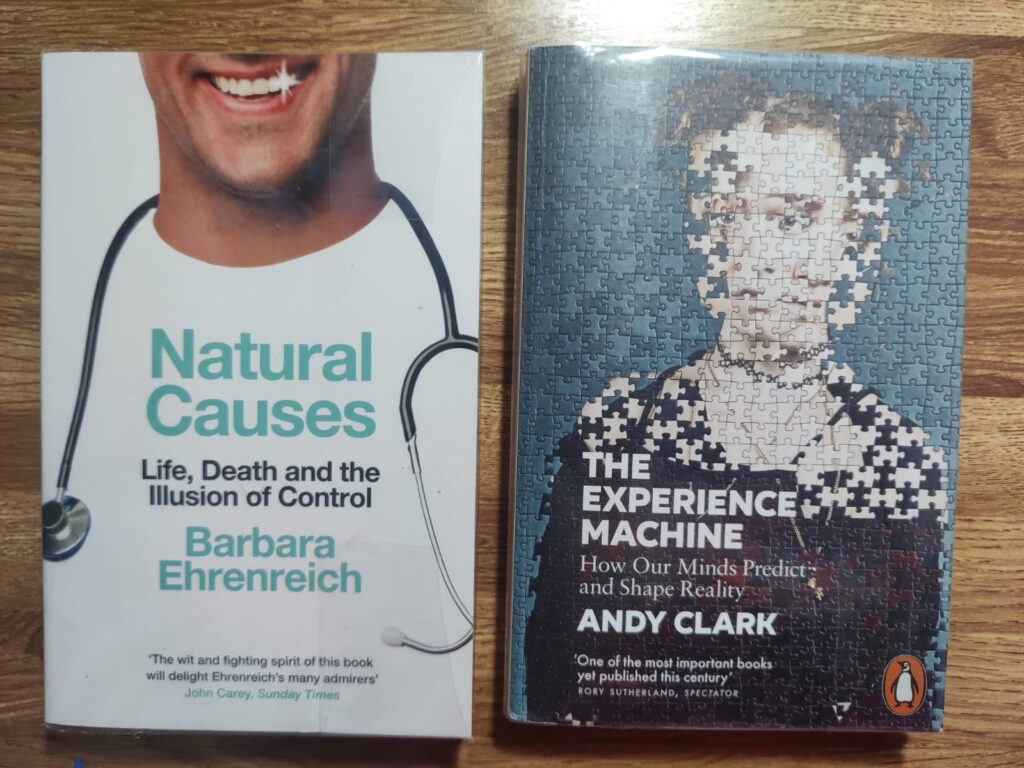
One of the five is ‘Longevity’, a new frontier that at least some are crazy for. A fascinating book to read in this context is Barbara Ehrenreich’s “Natural Causes: Life, Death and the Illusion of Control.”
And the other one is ‘Cognitive Augmentation.’ And the one to read related to this is Andy Clark’s ‘The Experience Machine: How Our Minds Predict and Shape Reality.”
Tail Piece 2: In 1986, when I was in Class 10, a bunch of friends and teachers tried convincing me to take up a role in a drama being played for school festival. My stage fright overtook my excitement and I refused. Something I really regret. Later in 2018, a good 32 years later, during a short sabbatical from work, I joined a short-term theatre course and played in front of an audience. Some forks offer chances for redemption later!