On March 15, 2013, at the Daikanyama station near Tokyo, a 1200-member workforce in a highly coordinated act (of magic) re-laid a railway track, converting an overground train station to underground station in just 3.5 hours! In the time between the last train in the night and the first train in the next morning, a track gets lowered, overhead trolley wires are removed, signalling is switched, test trains are run, and the track opens for operation. Even the word insane is not enough to explain this. A story that stops you on the tracks! Literally!
How does Japan do such incredible things? Some parts of the answer might lie in a slice of Japanese history.
Japan’s rise from a country totally devastated by the Second World War to one of the most technologically advanced nations is considered nothing short of a miracle. In 2024, we travelled to Japan. Precision in everything the Japanese do is what strikes first. The colour-coding on train platforms tells you exactly where a particular series of train stops, to the millimeter. Not to mention the cleanliness and civic sense.
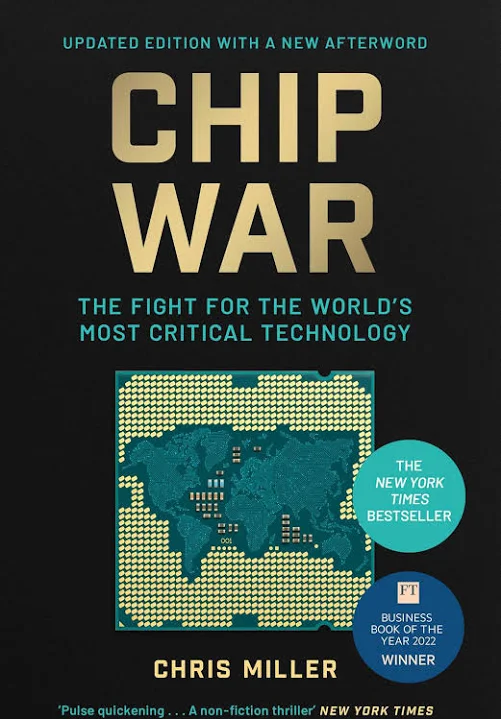
I wanted to read a bit about Japan before travelling, and as it happens in many plans for reading, it remained a plan. But the curiosity was only rising as we travelled around. Incidentally, the book I was reading during the trip was economic historian Chris Miller’s The Chip War: The Fight for the World’s Most Critical Technology. This acclaimed book of 2022 tells the story of the battle to control the commodity of the future—chips. The United States, China, and Taiwan are at the centre. But it also told the story of Japan, which, after the war, relied heavily on the United States for technology know-how. Once condescendingly being remarked as the “transistor salesmen” by the United States, Japan in less than two decades upended the American innovation engine, becoming the largest provider of high-quality, precision chips.
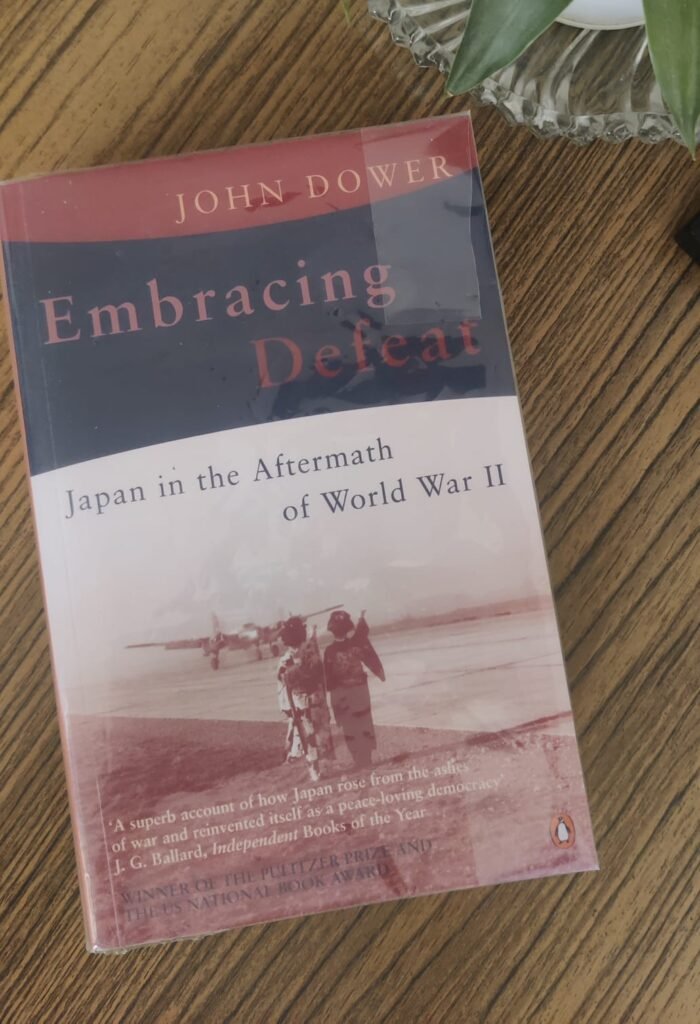
But this is not about Chip War. After returning from Japan, I searched for books on Japan and the most-cited definitive book was historian John Dower’s highly acclaimed and Pulitzer winning book, Embracing Defeat – Japan in the Aftermath of World War II. It was soon added in my Amazon wish list, only to be forgotten.
A couple of months back, at Simpliwise, I started working on a business consulting assignment for a Japanese client and interacting with a few Japanese leaders. Back to being a Japanophile, I quickly bought the book.
The 600+ pages traverse the history of Japan from the defeat and American occupation (1945) till the American departure (1952–53), while touching facts prior to 1945 and post-1953 in select contexts. The rise and fall of the Japanese empire is the story of a nation that was literally instigated to war by their ultra-nationalist leaders, claiming the superiority of the Japanese race and its ambition to rule the world, attacking and annexing regions as wide as from China to deeper Pacific, to a devastation that left millions stuck with poverty, violence, and long, brutal fight for survival.
The book focuses on what followed the defeat. And a complex interplay between the “victor and the vanquished.” For many, the end of war was a relief. But millions still starved to death. A shattered economy, corruption of the elite, and a thriving black market. Thousands of returning surrendered Japanese soldiers. And a country, in desperation, with even the communists welcoming the Americans.
For America, the plan was only for a short-term occupation, for political stability, creating a democratic state based on western liberal values, and avoiding any kind of re-grouping of ultra-nationalists (“demilitarise and democratize”). The first major effort was writing the new constitution. At one point, more than half-a-dozen conflicting interest groups were trying to write their own constitution. Between the official American and Japanese teams, with the clash of Meiji constitutional ideas and American liberal views, arguments, to-and-fros, this was the most complex exercise. A calculated move by United States was to free the Emperor from war crimes, keeping in mind the need for building stability in Japan and the Emperor himself issuing a decree that he is not divine and as much a human as the citizens were all part of this.
Then there was the rise of media, art, and literature, all perhaps attempts by the citizens trying to make sense of the chaos. There were people who couldn’t digest the defeat, but most were looking forward with some hope. There was a revival of communist and socialist ideas. People who once praised the Emperor and supported war changed their beliefs and narratives. The old industrial powerhouses were broken into smaller pieces.
But what was probably the most remarkable was the pause and reflection. The Buddhist idea of repentance. And taking a collective responsibility. By this time, the horrific atrocities the Japanese army had committed in other countries were public and well-known. A nation of 70+ million citizens collectively acknowledging that it was they who were responsible for their actions—the war, the defeat, and the devastation. Even the collections of writings of war criminals (never meant for publishing) had an “overwhelming feeling of waste, regret and sorrow,” and an “intense recollection of the terrible human costs of militarism and war.”
Literature, art, music, and cinema all contributed actively to this shifting internal narrative. The issue of “war responsibility was carried to the heart of cultural considerations.” “Ordinary people unaccustomed to writing for the public, such as housewives and farmers, wrote letters apologizing to the Chinese people and asking how the Japanese could make amends to such terrible behaviour.” A farmer wrote to the press “The crime is not that of the leaders alone, but rather all of us must bear the responsibility”. These were not isolated as hundreds of such response from ordinary citizens were reported. A hugely popular novel, the ‘Harp of Burma’ told the story of a soldier who witnessed the horrors of war and eventually turned to a priest. Despite being a serious work of literature, the book was made part of a popular series of books for children. Even the business communities called for self-reflection.
Seventy-plus million people calling for self-reflection and wanting to move from “losers of war” to “winners of peace!” Maybe there was no precedence to this in human history.
Along with that came a deep commitment to elevate the nation’s “science and spiritual power.” Cultivating scientific thinking ability became a mission (“Towards a country built on science”). Soon after the surrender, 500 million yen from former military funds were diverted to “promote science in everyday life.”
While America had not taken “any responsibility for the economic rehabilitation of Japan or strengthening its economy,” it somehow actively shaped it. Yet, America’s view of Japan remained as a “second-rate economy” meant to build cheap products for Asia (“a workshop for the Asia”).
But the Japanese planners had a different idea—to build an economy based on cutting-edge technology. A special advisory committee to the Ministry of Foreign Affairs made a draft report formulating this vision in 1946 itself. Being “economically colonized” is precisely what they wanted to avoid.
And the “maker of knickknacks and cheap appliances” in American and European imagination till the late 60s, Japan suddenly became the makers of high-quality automobiles and electronics goods taking the American and European markets by storm in less than a quarter of a century. By then, America’s armaments depended on high-precision Japanese electronics, which America could not manufacture themselves!
Ironically, the kick-starting of the Japanese economy started in 1950–51 by producing goods for Americans to fight the Korean war, though Japan did not join the war. Since the 1947 Constitution through its Article 9, Japan has permanently renounced war as a sovereign right and prohibited the maintenance of land, sea, or air forces for waging war.
For the curious, the book is an enriching read.